In today’s digital era, data is often referred to as the “new oil.” Every interaction, transaction, and digital footprint contributes to an ever-growing pool of information. At the heart of this data revolution lies Big Data, a concept that has become inseparable from the advancement of Artificial Intelligence (AI). Together, these two technological forces are transforming industries, reshaping economies, and redefining how businesses and societies operate.
Artificial Intelligence relies heavily on data to learn, adapt, and make intelligent decisions. Without vast datasets, AI systems would lack the necessary context and experience to function effectively. This is where Big Data plays a crucial role—providing the volume, variety, and velocity of information needed to train and optimize AI models.
This article explores the relationship between Big Data and AI, highlighting how Big Data fuels AI development, the technologies involved, real-world applications, challenges, and future trends.
Understanding Big Data
Big Data refers to extremely large and complex datasets that cannot be processed efficiently using traditional data-processing tools. It is commonly characterized by the “3 Vs”:
- Volume – Massive amounts of data generated every second.
- Velocity – The speed at which data is created and processed.
- Variety – Different types of data, including structured, semi-structured, and unstructured data.
In recent years, additional dimensions such as Veracity (data accuracy) and Value (usefulness of data) have been added to better define Big Data.
Sources of Big Data include:
- Social media platforms
- Internet of Things (IoT) devices
- E-commerce transactions
- Mobile applications
- Sensors and smart devices
These data sources generate continuous streams of information that AI systems use to learn patterns and make predictions.
What Is Artificial Intelligence?
Artificial Intelligence refers to the simulation of human intelligence in machines. AI systems are designed to perform tasks such as:
- Learning from data
- Recognizing patterns
- Making decisions
- Solving problems
- Understanding natural language
Key subfields of AI include:
- Machine Learning (ML)
- Deep Learning
- Natural Language Processing (NLP)
- Computer Vision
All these domains depend heavily on data. The more data available, the more accurate and capable AI systems become.
The Connection Between Big Data and AI
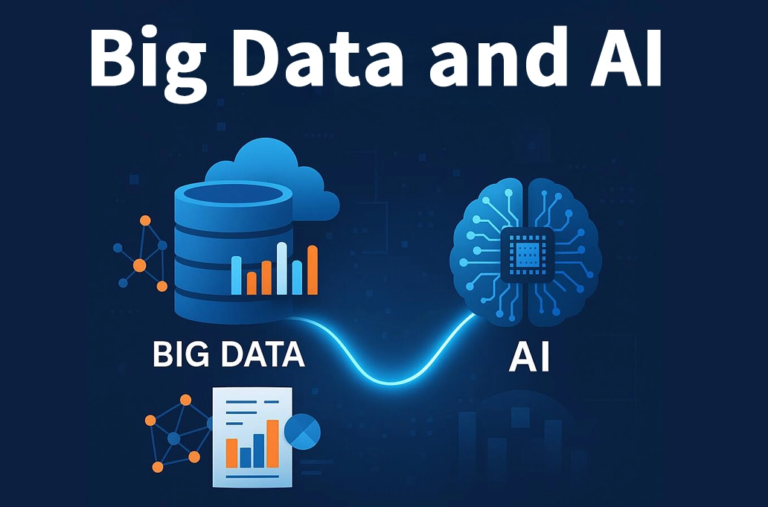
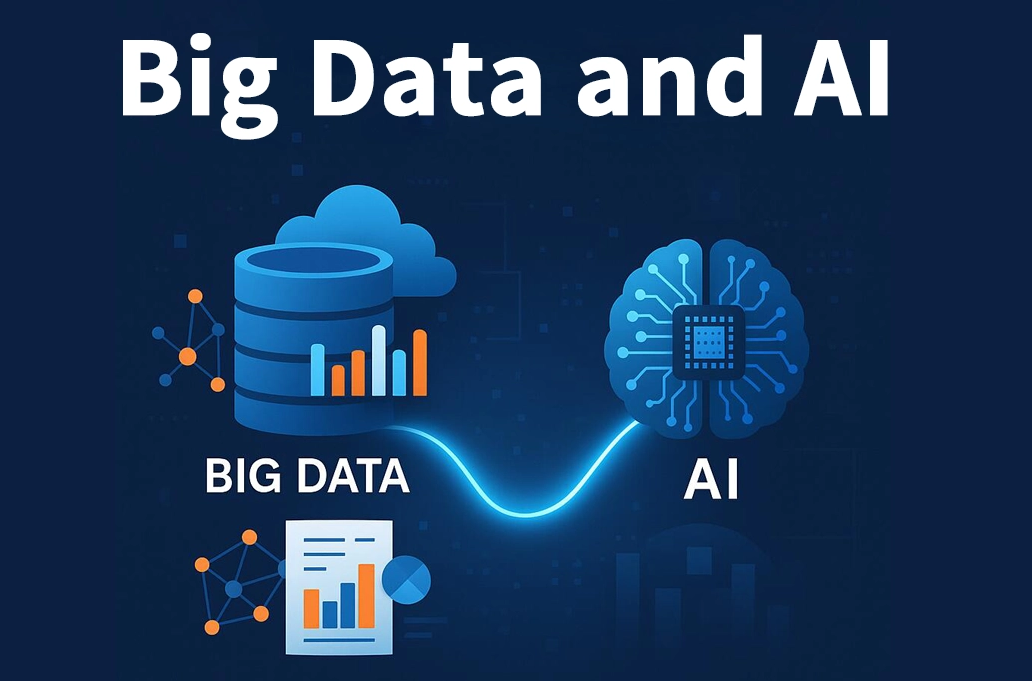
Big Data and AI share a symbiotic relationship:
- Big Data provides the raw material that AI needs to learn.
- AI provides the intelligence needed to extract insights from Big Data.
Without Big Data, AI models would struggle to generalize or improve. Conversely, without AI, Big Data would remain largely unstructured and difficult to analyze.
This interdependence has accelerated innovation across multiple sectors, including healthcare, finance, marketing, and transportation.
How Big Data Fuels AI Development
1. Training Machine Learning Models
Machine Learning algorithms require large datasets to identify patterns and relationships. The quality and quantity of training data directly impact model performance.
For example:
- Image recognition systems need millions of labeled images.
- Language models require vast text corpora.
- Recommendation systems rely on user behavior data.
Big Data enables:
- Better model accuracy
- Reduced bias
- Improved generalization
2. Enhancing Deep Learning Capabilities
Deep Learning, a subset of Machine Learning, uses neural networks with multiple layers to process complex data.
These models require:
- Massive datasets
- High computational power
Big Data supports deep learning by:
- Providing diverse datasets
- Enabling feature extraction
- Improving model robustness
Without Big Data, deep learning breakthroughs such as voice assistants and facial recognition would not be possible.
3. Real-Time Data Processing
Modern AI systems often operate in real time. Examples include:
- Fraud detection systems
- Autonomous vehicles
- Chatbots
Big Data technologies enable real-time data ingestion and processing, allowing AI systems to:
- Respond instantly
- Adapt dynamically
- Make timely decisions
4. Personalization and Recommendation Systems
AI-driven personalization relies on analyzing user data such as:
- Browsing history
- Purchase behavior
- Preferences
Big Data allows companies to:
- Deliver personalized content
- Recommend products
- Improve user experience
Popular examples include streaming platforms and e-commerce websites that tailor recommendations based on user activity.
5. Improving Predictive Analytics
Predictive analytics uses historical data to forecast future outcomes. Big Data enhances this process by:
- Increasing data diversity
- Improving prediction accuracy
- Enabling more complex models
Applications include:
- Demand forecasting
- Risk assessment
- Customer churn prediction
Technologies Bridging Big Data and AI
Several technologies facilitate the integration of Big Data and AI:
1. Distributed Computing Frameworks
Tools like Hadoop and Spark enable processing of large datasets across multiple machines.
Benefits:
- Scalability
- Faster processing
- Cost efficiency
2. Cloud Computing
Cloud platforms provide:
- Storage for massive datasets
- On-demand computing power
- AI development tools
This allows organizations to build and deploy AI models without heavy infrastructure investments.
3. Data Lakes and Warehouses
Data lakes store raw, unstructured data, while data warehouses store structured data.
These systems:
- Organize Big Data
- Enable efficient data retrieval
- Support AI training pipelines
4. Data Labeling and Annotation Tools
AI models require labeled data for supervised learning.
Big Data supports:
- Large-scale annotation processes
- Crowdsourced labeling
- Automated labeling techniques
Real-World Applications
1. Healthcare
Big Data and AI are revolutionizing healthcare by:
- Predicting diseases
- Personalizing treatments
- Analyzing medical images
For example:
- AI models analyze patient data to detect early signs of diseases.
- Big Data helps identify trends in population health.
2. Finance
In the financial sector, AI powered by Big Data is used for:
- Fraud detection
- Algorithmic trading
- Credit scoring
AI systems analyze vast transaction datasets to identify suspicious activities in real time.
3. Retail and E-Commerce
Retailers use Big Data and AI to:
- Optimize inventory
- Personalize shopping experiences
- Predict consumer behavior
This leads to increased sales and improved customer satisfaction.
4. Transportation and Autonomous Vehicles
Self-driving cars rely on:
- Sensor data
- GPS data
- Traffic information
Big Data enables AI systems to:
- Navigate environments
- Avoid obstacles
- Make real-time decisions
5. Marketing
Digital marketing has been transformed by Big Data and AI through:
- Targeted advertising
- Customer segmentation
- Campaign optimization
Businesses can now deliver highly relevant content to specific audiences.
Challenges in Using Big Data for AI
Despite its benefits, integrating Big Data with AI presents several challenges:
1. Data Quality Issues
Poor-quality data can lead to:
- Inaccurate predictions
- Biased models
- Misleading insights
Ensuring data accuracy and consistency is critical.
2. Data Privacy and Security
Handling large datasets raises concerns about:
- User privacy
- Data breaches
- Regulatory compliance
Organizations must implement strong security measures and adhere to data protection laws.
3. High Infrastructure Costs
Processing Big Data requires:
- Advanced hardware
- Scalable storage solutions
- Skilled professionals
This can be expensive, especially for small businesses.
4. Complexity of Data Management
Managing Big Data involves:
- Data integration
- Storage optimization
- Data governance
Without proper management, data can become overwhelming and unusable.
5. Talent Shortage
There is a growing demand for:
- Data scientists
- AI engineers
- Big Data specialists
The shortage of skilled professionals can hinder AI development.
Ethical Considerations
As Big Data and AI evolve, ethical concerns become increasingly important:
1. Bias in AI Models
AI systems can inherit biases from training data, leading to:
- Discrimination
- Unfair decisions
Ensuring diverse and representative datasets is essential.
2. Transparency and Explainability
AI models, especially deep learning systems, are often seen as “black boxes.”
Organizations must:
- Improve model transparency
- Provide explanations for decisions
3. Data Ownership
Questions arise about:
- Who owns the data
- How it is used
- User consent
Clear policies are needed to address these concerns.
Future Trends
The future of Big Data and AI is promising, with several emerging trends:
1. Edge Computing
Processing data closer to the source reduces latency and improves efficiency.
This is especially important for:
- IoT devices
- Autonomous systems
2. Automated Machine Learning (AutoML)
AutoML simplifies AI development by:
- Automating model selection
- Reducing the need for expertise
This makes AI more accessible.
3. AI-Powered Data Management
AI is being used to:
- Clean data
- Organize datasets
- Detect anomalies
This enhances the quality of Big Data.
4. Integration with 5G Technology
5G networks enable:
- Faster data transmission
- Real-time analytics
This will further accelerate AI applications.
5. Quantum Computing
Quantum computing has the potential to:
- Process massive datasets بسرعة
- Solve complex problems faster than traditional computers
This could revolutionize AI development.
Conclusion
Big Data plays a fundamental role in the development of Artificial Intelligence. It provides the foundation upon which AI systems are built, trained, and refined. From improving machine learning models to enabling real-time decision-making, Big Data is the driving force behind modern AI advancements.
As technology continues to evolve, the relationship between Big Data and AI will become even more critical. Organizations that effectively leverage both will gain a significant competitive advantage, unlocking new opportunities for innovation and growth.
However, challenges such as data privacy, quality, and ethical concerns must be addressed to ensure responsible and sustainable development.